
Regenerative braking transforms city travel by converting braking energy into electricity, improving efficiency and reducing costs. Here's what you need to know:
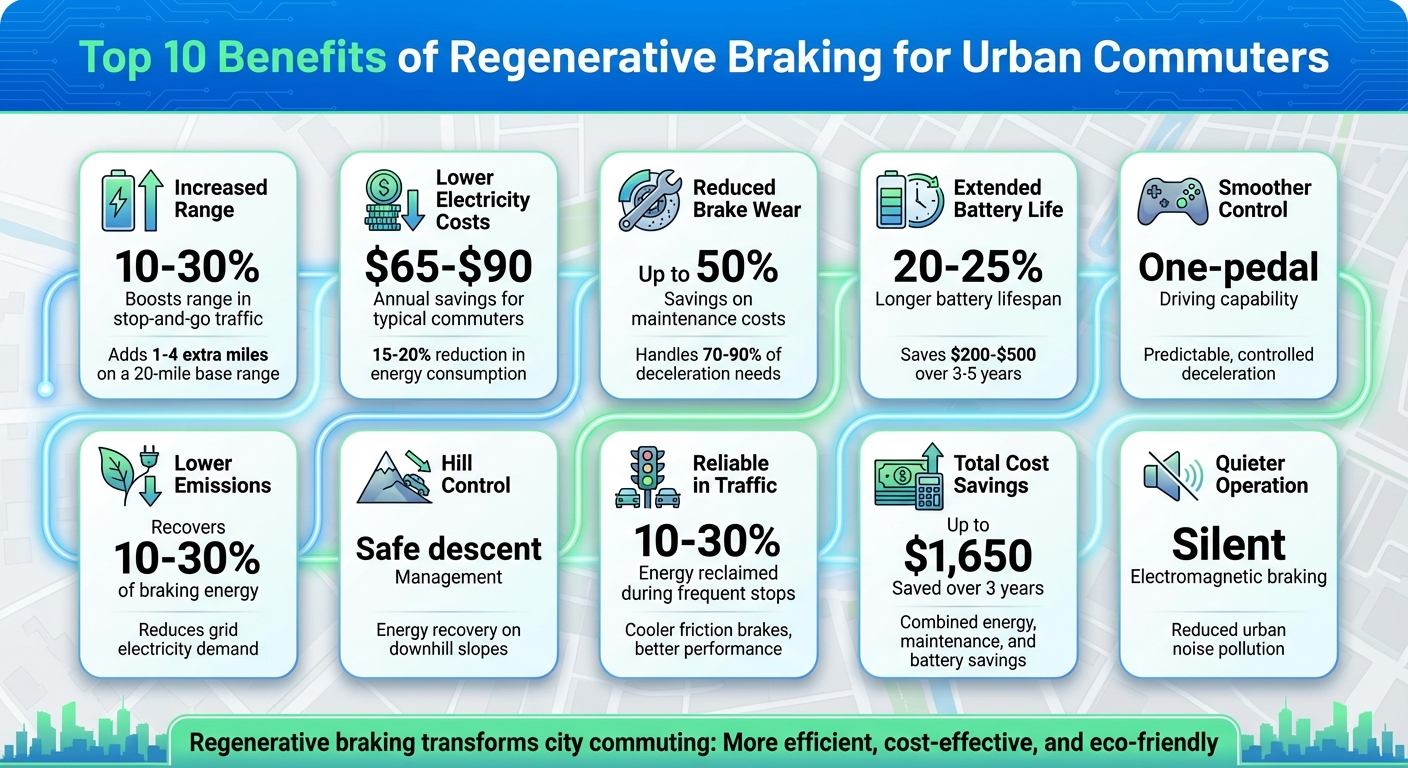
- Increased Range: Boosts range by 10–30% in stop-and-go traffic, adding extra miles per charge.
- Lower Costs: Cuts electricity bills and reduces brake maintenance by up to 50%.
- Battery Health: Extends battery life by 20–25%, delaying costly replacements.
- Smoother Stops: Offers controlled braking for safer city navigation.
- Cleaner Air: Lowers emissions and reduces brake-related air pollution.
- Hill Control: Provides safer descents while recovering energy.
- Quieter Rides: Minimizes noise compared to traditional brakes.
Devices like Wheelfeet electric roller skates highlight these advantages, offering extended range, reduced maintenance, and precise control - all while being compact and easy to use. Whether you're commuting by car, scooter, or skates, regenerative braking makes urban travel more efficient and cost-effective.
10 Key Benefits of Regenerative Braking for Urban Commuters: Statistics and Savings
Regenerative Braking: Turning Motion Into Electricity
How Regenerative Braking Works in Urban Mobility
When you hit the brakes or ease off the accelerator in an electric vehicle, something fascinating happens: the motor switches roles. Instead of pushing the car forward, it starts working in reverse, capturing the energy from the wheels' motion. This process converts kinetic energy into electricity, which is then sent back to recharge the battery. In simple terms, every time you slow down, you're giving your battery a little extra juice - turning frequent stops into small but meaningful charging opportunities.
In cities like Los Angeles, Chicago, New York, and San Francisco, where stop-and-go traffic is a daily reality, regenerative braking really shines. Each time you decelerate, energy is recaptured, potentially adding 1–3 miles of range during a typical 10-mile commute. Shorter trips, especially those under 5 miles, see even greater benefits since you're braking more often. Urban areas with dense street grids are particularly ideal for this technology - every red light, stop sign, or pedestrian crossing becomes a moment to recover energy.
This ability to recycle energy on the go is why regenerative braking has become a staple in urban mobility solutions. From electric cars to smaller innovations like electric roller skates, the technology turns the constant halts of city traffic into a surprising advantage, making urban travel not just manageable but smarter.
1. Better Energy Efficiency and Longer Range
One of the standout benefits of regenerative braking is the noticeable boost in range per charge. Research shows that in urban settings, regenerative braking can extend your range by about 10–30%. For a device with a base range of 20 miles, that means an extra 1–4 miles before needing to recharge. This improvement stems from a major shift in how braking energy is handled.
Traditional braking systems waste kinetic energy by converting it into heat. Regenerative braking, on the other hand, captures that energy and sends it back to the battery. According to Alpha Motor, electric vehicles can recover about 10–30% of braking energy during stop-and-go traffic. Since city driving often involves frequent, low-speed braking, each slowdown adds a bit more charge to the battery. Over time, these small gains add up, significantly improving overall efficiency.
Even for smaller urban mobility devices, the impact is impressive. Take the Wheelfeet 2, for example. It offers a 15.5-mile range on a single charge, but regenerative braking allows riders to go farther when navigating city streets filled with stoplights, crosswalks, and pedestrian-heavy areas.
2. Less Frequent Charging and Lower Electricity Bills
Regenerative braking helps stretch the time between charges by capturing energy every time you slow down. For urban commuters, this means getting more out of each charge. For example, an electric vehicle (EV) with a standard range of 200 miles per charge could see that range increase to about 220–260 miles with regenerative braking. Even smaller devices like electric scooters can gain an extra 2–3 miles, which might be enough to skip a charging session or two during a busy week. These extra miles directly translate to lower energy costs.
Over time, the savings on electricity add up. Let’s break it down: a commuter driving 10,000 miles annually in city conditions with an EV averaging 3.5 miles per kWh would typically use about 2,860 kWh per year. At $0.15 per kWh, that adds up to around $430. But with regenerative braking improving efficiency by 15–20%, energy usage drops to roughly 2,290–2,430 kWh. This brings the annual cost down to $340–$365, saving about $65–$90 per year.
City driving, with its frequent stops, makes regenerative braking even more effective. Urban conditions create constant opportunities to recover energy during deceleration, with studies showing efficiency improvements of up to 30% in such environments. For city commuters, this means fewer trips to the charging station and lower monthly electricity bills.
Smaller devices also benefit. Take the Wheelfeet electric roller skates as an example. Thanks to regenerative braking, users can handle more daily errands on a single charge. Riders report traveling significantly farther compared to traditional skates, making this technology especially helpful for commuting to work or school.
Another perk? It’s better for your battery. Since regenerative braking tops up the battery during deceleration, it reduces the need for full-charge cycles and prevents the battery from staying at low charge levels for long. This can extend battery life by about 20–25% in some light electric vehicles, cutting down the need for costly battery replacements over time.
3. Less Brake Wear and Lower Maintenance Costs
Regenerative braking works by converting kinetic energy into electrical energy, using the electric motor as a generator to handle most of the deceleration. Instead of relying heavily on the friction between brake pads and rotors, this system takes on the bulk of the work. In urban areas with frequent stop-and-go traffic, regenerative braking can manage a whopping 70–90% of the slowing needs, leaving the friction brakes for emergencies or the final moments of a stop. This not only eases the strain on mechanical components but also directly reduces maintenance needs.
With less wear and tear on brake parts, they last significantly longer. Consumer Reports highlights that EV owners can save up to 50% on maintenance costs compared to traditional gas-powered vehicles, thanks in large part to reduced brake wear. For city drivers constantly navigating traffic lights and congestion, this means fewer trips to the repair shop and lower repair bills over time.
Take Wheelfeet electric roller skates, for example. These skates combine regenerative braking with a responsive heel brake, minimizing the need for mechanical braking during frequent stops in urban settings. David S., a verified user, praised the feature, saying the "regenerative braking system is a great feature" for his daily commute.
The benefits extend beyond just parts. Less brake wear also means lower labor costs, as pads and rotors don’t need replacing as often. Fleet operators and rideshare drivers, who rack up significant mileage, see a notable advantage in reduced maintenance expenses when calculating total ownership costs.
If your vehicle or device allows you to adjust regenerative braking settings, opting for higher levels in city traffic can make a big difference. This approach lets the motor handle more of the deceleration, reserving the friction brakes for rare instances and further extending the lifespan of brake components. It’s a simple yet effective way to enhance efficiency while keeping maintenance costs down.
4. Smoother Stops and Better Control in the City
Regenerative braking slows you down by turning the energy from motion into electricity, making stops in city traffic smoother and more controlled. This not only improves the overall riding experience but also adds a layer of safety, especially in busy urban environments.
One standout feature of regenerative braking is the ability to drive with just one pedal. Simply easing off the accelerator activates the braking, eliminating the need to constantly switch between pedals.
This predictable way of slowing down reduces the chances of collisions and makes it easier to navigate around pedestrians and vehicles. It also helps with managing speed more precisely, cutting down on passenger discomfort and reducing fatigue during daily commutes.
A great example of these benefits can be seen with Wheelfeet electric roller skates. These skates use regenerative braking paired with a responsive heel brake, offering excellent control on crowded sidewalks and bike paths. One customer, Engel, shared their experience:
Wheelfeet deliver robust performance and excellent speed control, making them safe and enjoyable in urban settings.
The combination of regenerative braking and the responsive heel brake ensures a safer and smoother ride, no matter the situation.
If your device allows you to adjust regenerative braking settings, try setting it to medium or high for city use. This strikes a good balance between control and energy recovery, giving you a smoother ride in heavy traffic. Take some time to practice in quieter areas to get comfortable with adjusting the accelerator and building confidence.
5. Longer Battery Life and Health
Regenerative braking isn’t just about smoother stops - it also plays a big role in protecting your battery’s health, especially during frequent stops in urban settings. By converting kinetic energy into electricity and feeding it back into the battery, regenerative braking helps reduce deep discharge cycles, which are a leading cause of battery wear in electric mobility devices.
Without this system, batteries experience deeper discharge cycles that can speed up capacity loss. Regenerative braking, on the other hand, keeps the battery in a more stable charge range. This steady, partial recharging avoids the extreme highs and lows that can lead to problems like lithium plating or electrolyte breakdown. The result? A milder charging cycle that helps batteries last longer.
For everyday commuters, this can mean real savings. A battery designed to last 1,000 cycles instead of 800 could save you anywhere from $200 to $500 over three to five years. Considering replacement batteries typically cost between $400 and $600, those extra cycles make a noticeable difference in your wallet.
Take Wheelfeet electric roller skates, for example. They use regenerative braking to preserve battery health during city commutes. The system recovers energy during downhill rides and stops, easing the strain caused by repeated full accelerations across varied urban terrains.
What’s more, regenerative braking doesn’t just save energy - it helps maintain your battery’s performance over time. Using higher regenerative braking settings in city environments encourages frequent partial recharges during stops. This keeps your battery operating within a healthier charge range, ultimately extending its lifespan.
6. Lower Emissions and Cleaner City Air
Regenerative braking helps lower emissions by reducing the demand for grid electricity during acceleration. By capturing and reusing kinetic energy, it lessens the need for additional power from the grid. In the U.S., where much of the electricity still comes from fossil fuels, every kilowatt-hour saved translates to fewer emissions of CO₂, nitrogen oxides, and particulate matter.
The numbers tell the story. Take a typical urban commuter driving 10,000 miles a year. If regenerative braking cuts energy consumption by 20%, an electric vehicle that originally uses 0.30 kWh per mile would drop to about 0.24 kWh per mile. That’s a savings of roughly 600 kWh annually - preventing the release of hundreds of pounds of CO₂ and other pollutants. This not only reduces operating costs but also makes a noticeable difference in cutting harmful emissions in cities.
The benefits grow even more with widespread use. Fleet vehicles like taxis, delivery vans, and ride-sharing cars see huge advantages in stop-and-go traffic, where frequent braking allows them to recover more energy. On a larger scale, this reduced energy demand helps cities meet air quality goals and lessens reliance on high-emission power plants during peak times.
There’s another bonus: less use of friction brakes means fewer fine particles released from brake pads and rotors. This improvement in local air quality can have a positive impact on urban respiratory health.
Even smaller devices contribute to cleaner air. For example, Wheelfeet electric roller skates use regenerative braking to extend their range and reduce how often they need charging. When commuters opt for these lightweight, eco-friendly options for short trips instead of cars, it further cuts down fuel use and grid demand - reducing both greenhouse gases and local air pollution.
sbb-itb-bf837b9
7. Better Control on Hills and Slopes
Regenerative braking offers a smarter way to manage downhill travel for urban commuters. By using the electric motor as a generator, it naturally resists wheel motion, creating smooth deceleration that prevents runaway speeds on steep descents. This built-in resistance ensures predictable braking, reducing the risk of wheel lockup - a crucial feature for navigating sharp turns on city streets or steep residential roads.
What’s especially clever is how this system pulls double duty. While keeping speeds in check, it also captures the energy generated by gravity and motion, converting it into battery power rather than wasting it as heat. For commuters in hilly cities across the U.S., this means safer descents and a boost in overall range, especially on routes with varying elevations and traffic demands. In heavier vehicles, regenerative braking not only controls speed on downhill stretches but also stores energy to assist with the next climb.
Many electric vehicles and personal mobility devices now include adjustable regenerative braking settings, allowing users to fine-tune how much motor resistance they want. For steep hills, stronger resistance can help maintain control, while gentler settings are ideal for flatter routes. This flexibility reduces the need to constantly rely on traditional friction brakes, cutting down on heat buildup and wear. It’s a perfect fit for urban driving, where elevation changes often require precise braking control.
Take Wheelfeet electric roller skates, for example. Their regenerative braking system uses motor resistance to provide controlled descents while simultaneously recovering energy. Riders can adjust their speed with a wireless remote, making downhill travel safer and more stable. This kind of system boosts rider confidence when dealing with elevation changes in busy urban areas.
Another perk? Regenerative braking extends the life of mechanical brakes by taking on much of the braking workload during descents. This is especially useful on routes with frequent elevation changes - think bridges, overpasses, or hilly neighborhoods. Each downhill stretch becomes an opportunity to safely manage speed, recharge the battery, and reduce wear on traditional brakes. More efficient braking means longer trips and fewer interruptions for charging, all while keeping mechanical brakes ready for emergencies.
8. More Reliable Performance in Stop-and-Go Traffic
Rush-hour traffic can be tough on traditional friction brakes, but regenerative braking offers a smarter solution. Instead of relying solely on friction to slow down, regenerative systems use the vehicle's electric motor to convert kinetic energy into battery power. This process not only reduces heat buildup but also keeps friction brakes cooler, ensuring steady and dependable performance even in stop-and-go conditions.
Studies show that regenerative braking can reclaim 10–30% of energy during frequent stops, with the most noticeable benefits in urban settings where braking happens often. For smaller vehicles like e-scooters, this system can boost range by 10–15% in city environments.
Many electric vehicles and mobility devices now feature one-pedal driving or high-regeneration modes. In these modes, simply easing off the accelerator slows the vehicle smoothly, eliminating the constant need to switch between pedals. This makes it easier to maintain safe distances in traffic, avoid abrupt stops, and minimize wear on mechanical brakes. For compact urban devices, this is a game-changer.
Take, for example, urban mobility devices like Wheelfeet electric roller skates. Regenerative braking handles frequent micro-stops - navigating crosswalks, bike lanes, and crowded sidewalks - without overheating fragile mechanical parts.
To get the most out of regenerative braking in heavy traffic, consider setting your device to a higher regen level during city commutes. Plan your stops ahead of time and coast into slowdowns instead of braking hard at the last second. This approach keeps the motor in its optimal energy recovery range and reduces strain on your friction brakes. The result? Longer-lasting brakes, smoother stops, and more energy recaptured - all while ensuring reliable performance during those rush-hour slogs.
9. Lower Total Ownership Costs Over Time
Regenerative braking doesn’t just improve efficiency - it also helps save money in the long run. By cutting energy use, reducing maintenance needs, and delaying battery replacements, it can save urban commuters up to $1,650 over three years. Let’s break it down: for someone in the U.S. commuting 10 miles daily, regenerative braking that extends range by about 20% could save around $150 annually on charging costs (based on an electricity rate of $0.15 per kWh). Add to that $200 a year in maintenance savings and the ability to delay a $500 battery replacement, and the numbers add up quickly. Consumer Reports even found that EV owners spend up to 50% less on maintenance compared to those driving gas-powered cars, thanks largely to less brake wear. On top of that, regenerative braking can extend battery life by 20–25%, reducing how often replacements are needed and further lowering costs.
For smaller electric devices like scooters, the benefits are just as clear. Industry data shows regenerative braking can add 10–15% more range, meaning fewer charges and longer-lasting batteries. This is particularly valuable for urban commuters who deal with frequent stops and varied terrain. All told, users can save $500 or more annually through a combination of lower energy costs, reduced maintenance, and extended battery life. Take electric roller skates, for example - models like those from Wheelfeet use regenerative braking to cut down on charging needs and extend the life of their components, making them a smart financial choice for city commutes.
Over a three-to-five-year period, these savings really add up, especially for those navigating stop-and-go traffic or hilly routes. Devices equipped with regenerative braking prove to be a cost-effective option for urban travel.
10. Quieter Rides Through the City
Regenerative braking works silently, relying on the motor's electromagnetic resistance instead of the friction-based system found in traditional brakes. Unlike friction brakes, which create noise and wear due to constant contact, regenerative braking takes on most of the deceleration in stop-and-go city traffic. This means friction brakes are used less frequently and with less intensity, reducing the noise typically associated with braking at intersections, traffic lights, or during heavy congestion. The result? A quieter, more comfortable ride that complements urban living.
This noise reduction isn’t just a perk for riders - it benefits pedestrians too. Instead of the sharp squeal of mechanical brakes, regenerative braking produces only a faint motor hum at certain speeds, which is far less disruptive. For urban commuters navigating busy bike lanes, crosswalks, or shared paths, this quieter operation translates to smoother and more peaceful journeys, free from the jarring sounds that can heighten commuter stress.
The impact extends beyond individual comfort. In densely populated U.S. cities, much of the street noise comes from engines, exhaust systems, and mechanical braking - especially from vehicles like buses, taxis, and delivery trucks that frequently stop and start. As more vehicles and personal mobility devices incorporate regenerative braking, the collective reduction in brake squeals and other harsh sounds can significantly decrease ambient noise levels on bustling streets.
Smaller electric devices, such as scooters and electric roller skates, also benefit from regenerative braking. These systems allow riders to slow down smoothly without over-relying on mechanical brakes, which can squeal or chatter when wet, dirty, or poorly adjusted. For example, Wheelfeet electric roller skates use regenerative braking to manage speed on descents or crowded sidewalks, reducing brake noise right at ground level. This creates a quieter, more seamless experience when slowing for crosswalks, merging into bike lanes, or navigating park paths, making them ideal for low-impact commuting in busy urban settings.
To make the most of this quiet deceleration, riders can opt for stronger regenerative modes, saving mechanical brakes for emergencies. By anticipating stops and maintaining steady speeds, riders can coast earlier, recovering energy and enjoying quieter, more efficient slowing.
Regenerative Braking in Electric Roller Skates
Electric roller skates bring regenerative braking technology into a compact and portable design, catering to urban commuters looking for a lightweight and practical solution. Similar to larger electric vehicles, Wheelfeet skates shift roles during deceleration to recharge their battery. This means every time you slow down - whether at a crosswalk, traffic light, or navigating a crowded sidewalk - you’re recovering energy that extends your ride. It’s a straightforward concept with clear perks for city commuters.
For those tackling last-mile trips in U.S. cities (typically 1–3 miles between transit stops and destinations), regenerative braking can make a noticeable difference. In stop-and-go urban conditions, similar lightweight electric vehicles have shown a 10–15% boost in range. For example, a rider with an 8-mile range might see it increase to around 8.8–9.2 miles under frequent braking. Additionally, this system reduces the strain on batteries, extending their lifespan by 20–25% by minimizing deep discharge cycles. These advantages make electric roller skates an appealing choice for eco-conscious and budget-minded commuters.
Weighing just 4.8 pounds each - 70% lighter than electric scooters - Wheelfeet skates are designed with portability in mind. They’re small enough to stash in a backpack, solving the storage challenges often faced with bulkier devices. Riders also benefit from an enhanced range and simplified charging. With speeds up to 15 mph and a wireless remote for speed control, users can manage deceleration smoothly through electromagnetic resistance. This approach offers more precise control compared to relying solely on mechanical brakes.
Regenerative braking doesn’t just improve performance; it also saves money and enhances durability. By handling most routine slowing, it reduces wear on friction-brake components by up to 50%. On hills and slopes, the system provides controlled resistance - similar to engine braking - preventing runaway acceleration while recovering energy from gravity.
To get the most out of regenerative braking, adjust your riding habits. Anticipate stops early and ease off the throttle to engage the system gradually, avoiding abrupt mechanical braking. Opt for routes with smoother, slower traffic where regenerative braking can activate more often, and try to avoid hard stops and rapid acceleration. With electricity costs in the U.S. averaging about $0.15 per kWh, even small amounts of recovered energy can reduce charging expenses, further highlighting the practicality of Wheelfeet skates.
Tradeoffs and Technical Factors to Consider
Regenerative braking offers some clear advantages for urban commuting, but it also comes with certain tradeoffs that influence its overall performance. In real-world urban settings, regenerative braking typically recaptures only about 10–30% of braking energy. These recovery rates depend on several important factors.
One key factor is speed. The system performs most efficiently at lower to moderate speeds, around 10–30 mph, making it well-suited for city driving. However, at higher speeds - above 50 mph - its efficiency drops significantly. Terrain and riding habits also play a role. Flat city streets with frequent stops create ideal conditions, while steep downhill slopes often require friction brakes. Smooth, gradual braking allows more energy to be recovered compared to sudden stops, which convert energy into heat instead.
Battery conditions further impact regeneration efficiency. For instance, when the battery is nearly full (above 90% charge) or when temperatures are extreme, efficiency can drop by 10–20%.
To address these limitations, some systems, like Wheelfeet electric roller skates, combine regenerative braking with a responsive heel brake. This dual setup ensures reliable stopping power even when regenerative braking alone isn't enough.
Here's a quick comparison of regenerative braking and friction braking across key aspects:
| Aspect | Regenerative Braking | Friction Braking |
|---|---|---|
| Energy Use | Recovers 10–30% of braking energy | Converts energy into heat |
| Component Wear | Reduces wear on pads and rotors by up to 50% | Higher wear, requiring frequent maintenance |
| Stopping Power | Moderate braking, best for urban speeds | Reliable across all conditions |
Conclusion
Transforming kinetic energy into electricity can increase efficiency by as much as 30% while extending vehicle range by 10–30%. This translates to fewer charging stops and reduced costs. On top of that, regenerative braking minimizes brake wear - by up to 50% - which means lower maintenance expenses and smoother, more controlled stops, especially in heavy stop-and-go traffic. It also helps cut emissions and extends battery life by approximately 20–25% through constant micro-recharging.
Take the Wheelfeet electric roller skates as an example. These skates, equipped with regenerative braking, can hit speeds of up to 15 mph and cover a 9-mile range. They’re a smart, eco-friendly choice for short commutes, letting you avoid traffic jams and save time without dealing with parking headaches or transit delays.
Some models even include adjustable regenerative braking, giving you the ability to fine-tune energy recovery and control. By easing off the accelerator ahead of stops, you can maximize energy recovery and reduce dependence on traditional friction brakes. In the end, regenerative braking offers a practical, cost-effective, and environmentally friendly solution for urban transportation.
FAQs
How does regenerative braking help extend battery life for urban commuters?
Regenerative braking works by capturing the kinetic energy produced when you slow down or stop and converting it into electrical energy. This energy is then used to recharge the battery, helping to reduce the frequency of charging and boosting overall energy efficiency.
In busy urban settings with constant stop-and-go traffic, regenerative braking becomes especially useful. It can significantly cut down energy use, offering a more eco-friendly and budget-friendly option for daily commuters.
How does regenerative braking help city commuters save money?
Regenerative braking offers urban commuters a practical way to save money by capturing energy that would otherwise be wasted during braking and turning it into usable power. This process helps cut down on the energy required for transportation, which translates into reduced long-term costs.
For those relying on personal electric transportation - like electric roller skates - regenerative braking doesn’t just improve energy efficiency. It also reduces strain on traditional braking systems, lowering maintenance costs and keeping repairs to a minimum.
How does regenerative braking help improve air quality in cities?
Regenerative braking works by capturing kinetic energy that would otherwise be lost as heat during braking and converting it into electricity. This electricity is then used to recharge the vehicle's battery. The result? Less reliance on fossil fuels, which means fewer harmful emissions and cleaner air - especially in crowded urban areas where air quality is often a concern.
By improving energy efficiency and reducing the wear and tear on traditional braking systems, regenerative braking contributes to the goal of healthier, more eco-friendly cities. It’s a step forward in making urban living more sustainable.


Leave a comment
All comments are moderated before being published.
This site is protected by hCaptcha and the hCaptcha Privacy Policy and Terms of Service apply.